
This year, as the government considers the size and composition of the 2026-27 Migration Program, it will need to balance several competing pressures that have moved firmly into the public spotlight:
- Elevated Net Overseas Migration levels
- Political calls for tighter population control and
- Ongoing demand for a stable, skilled workforce
For organisations with global talent, understanding the direction of this debate is essential.
Current signals emerging from experts and former policymakers point to a skilled migration program that could become more selective, tightly managed, and explicitly tied to long‑term economic needs.
Net Overseas Migration pressures
Net Overseas Migration (NOM)
Refers to population changes driven by the net difference between the number of international arrivals and departures over a 12-month period.
A positive number means more people moved to a country than left. It includes all travellers, including temporary visa holders, permanent residents, and citizens.
NOM has become a central political and policy challenge. Infrastructure planning has historically been developed to numbers set out in the permanent migration program, rather than NOM and temporary migration.
Despite recent tightening measures for student and visitor visa holders, Australia continues to experience historically high levels of temporary migration.
This scale places pressure on housing, infrastructure, and public confidence — and political calls to kerb the NOM are likely to shape the government’s approach to the next migration program.
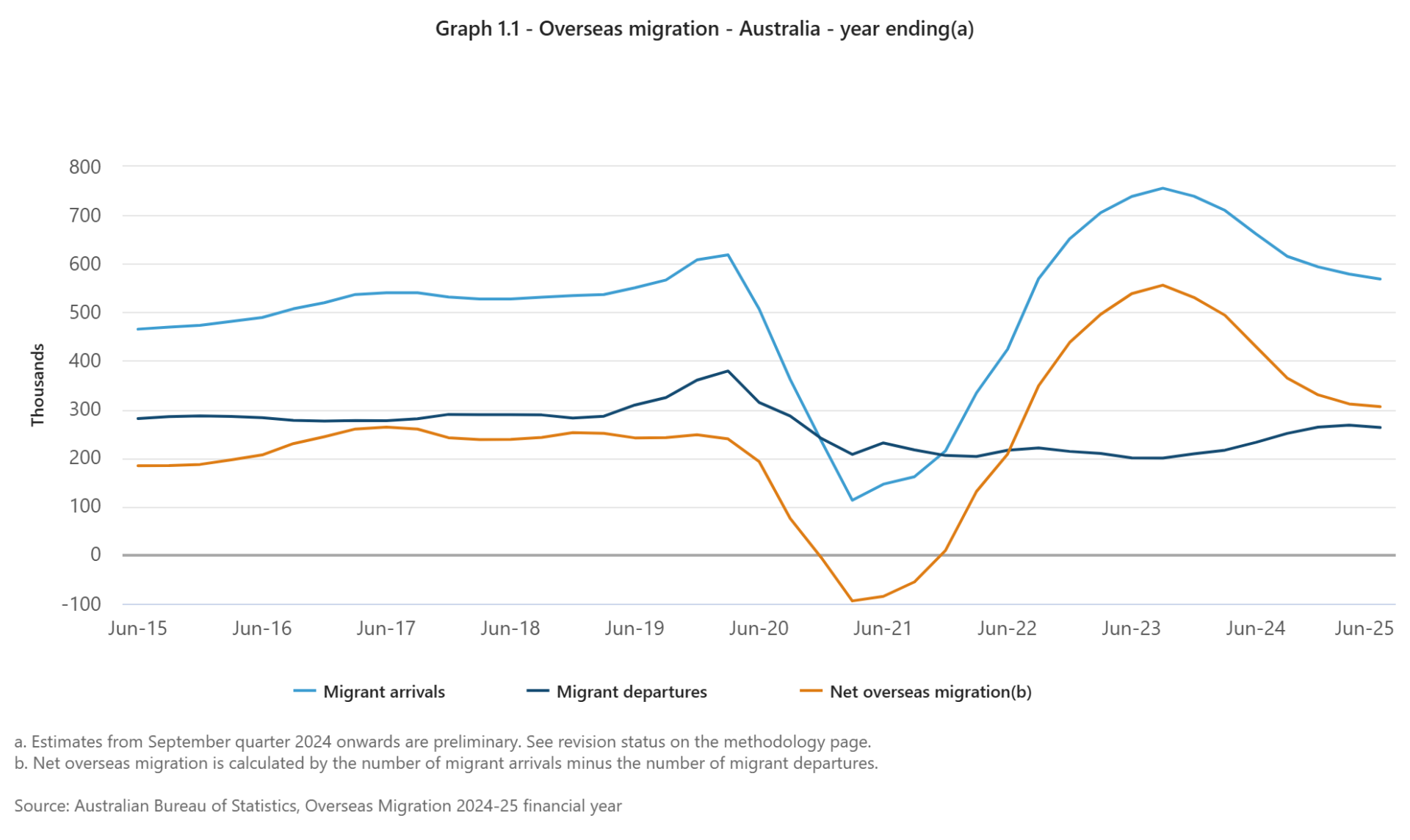
While the NOM has fallen since its post-COVID peak in 2022-23, the latest net migration data indicates Australia is making progress but is still yet to return to pre-pandemic levels.
NOM trends
- 2022-23 NOM: 538,000
- 2023-24 NOM: 429,000
- 2024-25 NOM: 306,000
- 2025-26 NOM forecast: 260,000
Source: Australian Bureau of Statistics, Dec 2025 and FY 2024-25, 2025 Population Statement, Treasure Ministers, Jan 2026.
Demographic views on how NOM should be controlled
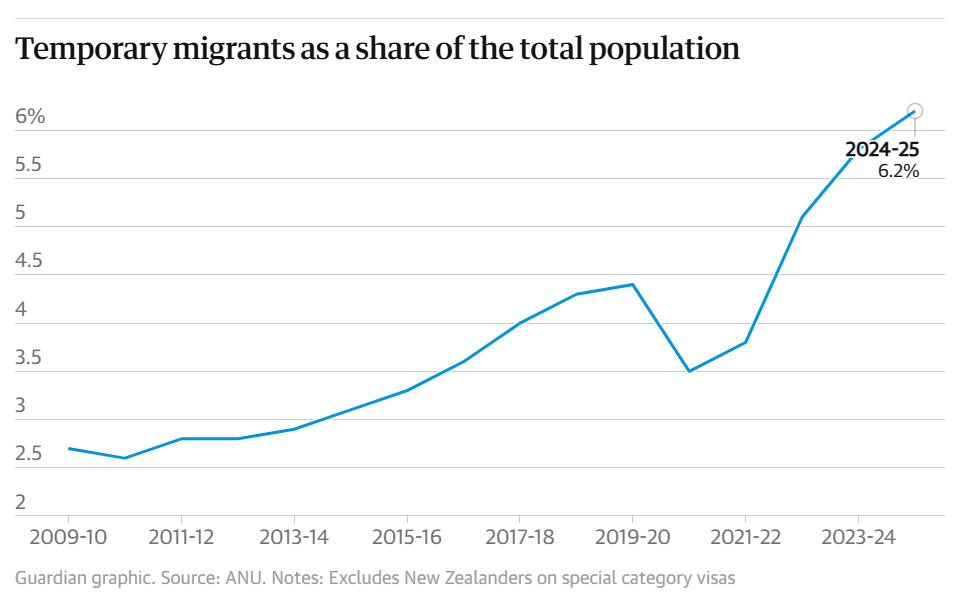
In a recent report, Governing Temporariness in a Settlement State: Why Net Migration Targets Fail and What to Do Instead, demographers Alan Gamlen and Peter McDonald from the ANU Migration Hub argue that the issue lies in governing the ‘scale of temporariness’ rather than chasing NOM targets.
Scale of temporariness
Temporary migrants as a share of the total population more than doubled over the past 15 years, from 2.7% in 2010 to more than 6% in 2024-25.
Source: The Guardian and ANU.
Gamlen and McDonald propose aligning temporary net inflows with the number of temporary-to-permanent placements permitted in the permanent migration program so that temporary migration cannot drift beyond what Australia can sustainably absorb.
This approach raises several questions about the balance between temporary migration and long-term settlement, such as the role of temporary migration in the labour market, its impact on a worker’s sense of belonging, and how Australia should adjust temporary-to-permanent migration settings.
Other views
In a proposed Cabinet submission, Former Deputy Secretary of Home Affairs and media commentator Abul Rizvi argues that controlling the NOM requires:
- Tightening temporary skilled entry, including restoring higher work‑experience thresholds
- Increasing the permanent program for employer‑sponsored and partner visas, while reducing independent and state‑nominated places
- Student and graduate visa reform by limiting courses and providers that do not lead to skilled outcomes
Rizvi’s position is pragmatic: Australia should not attempt a blanket reduction in skilled migration and should avoid cutting skilled visas in a way that harms the economy or deprives employers of needed talent.
By emphasising employer-sponsored pathways, Australia should tighten temporary visa pathways that may not lead to genuine skilled outcomes.
Sustainable people strategy: Global talent
With NOM reductions on the horizon, we may indeed see the government refocus on the nation’s long-term skilled migration needs.
The government is shifting towards a longer-term (multi-year) planning approach to better match migration with infrastructure capacity, moving beyond the 12-month cycle.
We expect employer-sponsored pathways will continue to be prioritised and skilled migration will remain strong but may become more targeted and focused on occupations and industries with long-term demand.
Interstaff supports employers requiring sustainable global talent strategy to strengthen workforce capabilities.
Access our immigration insights to explore:
- Work rights and visa conditions
- Skilled visa changes
- Temporary and permanent visa pathways